Episode Transcript
[00:00:00] Lisa Carley: I think we have to be careful of making a moral judgment of our students that are using it that I feel pretty strongly about. And I think, to kind of summarize what I was saying before, our demands are increasing, but we're not being mindful of the impact on. On those demand of those demands on our students.
So when I talk with my students openly about it, they, across the board, they're like, I'm overwhelmed.
They're just overwhelmed. And so when I, again, because, like, I have a mental health background and like, I really, for me, the most important thing is that my kids are okay. Right. Like, I want them to be mentally, psychologically, psychically, okay.
So when I hear consistently that my students are overwhelmed, I see it. I see how exhausted they are. Then I think that, like, how we talk about the use of AI, One should be with that lens. There is a tool that's available.
Students have access to it. And how do we, as a culture, as an educational culture, both from the student perspective and from the teacher perspective, where our goal is for students to be learning critically, thinking, engaging with dissonant, you know, ideas. How do we then have that conversation and frame it in such a way where we're not punishing them for using a tool that's actually helping their mental health? Right. And I guess that's kind of, you know, the. The tension point that. That I'm really thinking about going into the next school year is like, we have, you know, obviously we have a no AI policy.
That's great that we have that policy. That's perfectly fine. But I can tell you, all my students are using it, so it's fine.
Say my students can sign an agreement. Oh, yeah, we didn't use AI for this. They're using AI. I know that they are. Whether they're using it to write the totality of their essays is another matter, but they are using it.
And so, you know, I guess, like, I had sort of like tossed the ball in your court, Rich. Like, you know, what is your experience both institutionally and then you yourself as an instructor? What. What feedback do you get from your students? Like, in general, kind of, how are you handling it in the classroom?
[00:02:23] Rich Grego, Ph. D.: Yeah, I think among, you know, in higher education, anyway, institutions are not ready for it. So they're kind of like, I just use this haphazard way. Probably all schools are doing this, right? They're. They're ostensibly, you know, they have to play to the. Or account for the worst case scenario, which is, you know, students just have to use this technology.
They're going to use the technology and it's there. And the worst case scenario that I think schools are concerned with are that obviously students are going to use it to write their papers. And you see that all the time.
And then there's all the again, the popular There's a famous book now is a New York Times bestseller if anybody wants to get it. I forget the title, but the author is Jonathan Haidt, I may have mentioned this previously, who's a psychologist, famous social moral psychologist now is a public intellectual sort of figure now too. And he wrote a, he wrote this very well known New York Times bestseller about the negative effects of AI.
[00:03:33] Lisa Carley: Yes. Yes. Yeah.
[00:03:34] Rich Grego, Ph. D.: And so students so schools are sort of burying, they're partly burying their heads in the sand. They're doing as Lisa, as you said, they're issuing these policies against AI. Assuming again the worst case scenario students are going to use to write their papers, which they do, and then just assume students are going to abide by those things and then when they don't, that you'll devise some clever way without accusing them of plagiarism, which you can't prove and keep them from doing that, which there's no way you can really do. So overwhelmed, I think in the academic world, I don't know if you feel the same way. My other question was sort of it's kind of a question to you.
But before that, let me just say again, interestingly now as you know, I'm a pretty active sort of scholar and right now I got like six projects out there in the ether but one of the things I'm doing is submitting a couple of with a co author that I met through you guys actually.
But submitting a couple of papers to some leading very prestigious journals now in the field. And interestingly I usually write a letter of inquiry to the editors before I send them anything, just warning sort of and get any feedback from them. And I wrote one to the letter telling them a letter to the editor telling them me and this guy are sending this other scholar is sending you this paper. And the only response he wrote back was yeah, he said it sounds appropriate and everything. But just be sure you make you're aware of our no AI feed of our no AI policy.
[00:05:15] Lisa Carley: Yep, yep, this is happening.
[00:05:18] Rich Grego, Ph. D.: I mean it's hard to conceive but scholars are sending AI written papers apparently to the leading journals in the but my question to you was and again, the other feedback I've been getting and this is why I'm wondering if maybe it's the Kind of student that you have your constituency, you're not. That students are more under, more pressure than ever, but rather that in public schools they're doing less than ever again. And I don't know if this is the case. I have no idea. You would know better than I would, I guess.
But my guess is that you have sort of elite students.
[00:05:59] Lisa Carley: Yes, that is true. Yes.
[00:06:01] Rich Grego, Ph. D.: Or elite schools.
[00:06:02] Lisa Carley: That is correct.
[00:06:04] Rich Grego, Ph. D.: With families that are just the type of families that are. That do. That are putting them through the paces and. And expecting them to go to these elite schools and prepping them for it. So my guess is that they would be living a kind of life academically that most kids in most public schools have no conception of and don't have those expectations anyway. This is the impression you get now, is that with you? I don't know from a practical standpoint.
[00:06:34] Lisa Carley: Oh, I definitely think. I mean, you know, I teach at a private school. I teach at one of the best private schools schools in the United States. And, you know, and my students are coming from families that highly value education.
You know, the education was the thing that allowed them to be successful and many of them to emigrate out of, you know, whatever countries they came from. And you know that. So education is very, very highly valued.
No doubt about it. Like, no doubt about it.
[00:07:05] Rich Grego, Ph. D.: I get it. Because I would imagine to get into an elite school with the kind of pressure competition you must, you've got to pressure yourself through. Through high school, right? Just got to do a million things perfect. And like a musician trying to get into the New York Philharmonic, right? You've just got the best. Never make a mistake, do everything just right. And them, I get it, because they have a goal in mind that they're driven toward and they don't have time for bullshit. And I bet if, you know, if they're under pressure, they're like, you know, for this one petty task, I've got to get through, why not?
[00:07:45] Lisa Carley: Right, right, right, right, exactly. Yeah.
[00:07:50] Rich Grego, Ph. D.: With them as well.
[00:07:51] Lisa Carley: And I do too worry about, you
[00:07:54] Rich Grego, Ph. D.: know what I'm saying?
[00:07:55] Lisa Carley: And I really, I mean, I genuinely sympathize with them. And I don't want to be seen as kind of the arbiter of right and wrong of being a moral arbiter here, right. Because I think there's a bigger moral picture that needs to be considered. And so I think that the interesting thing, or I guess the way that I've tried to handle it is I want to make the content of what we do in class engaging enough and interesting enough that they see the value of it, right?
So whenever, like when we were talking about our previous novel, like, there were genuine moments where I saw the light bulb go off for my students. And even there were several times that they did, you know, like the fist exploding kind of, you know, like, like, oh, I got it. You know, I mean, that's like the most gratifying thing a teacher can ever hope for, you know, so it's like, oh, yes, okay, this is great. Like they're, they're into it. And so I think that, like, the approach that I've tried to take with it is to really get them to see the intrinsic value of feeling that joy of the critical thinking, the joy of, oh my go. Like, I was able to connect some dots in my mind because the ability to do that in an English class is also going to help them. No matter where they go, whether they become engineers or doctors or, you know, whatever it is that they go on to become. And especially because, you know, we're in, you know, we're in the Bay Area and we're in kind of Silicon Valley, many of these people are going to go on to become highly influential tech people.
And if the skills that we can teach them at this level can include an intrinsic joy of learning and connecting the dots, man, that's like, I'm really happy that, you know, my kids can walk away with that and see how, like, what I try to do is I'm. And I don't want to say that this is like circumventing the use of AI. I just want to do like a little bit of a side piece. I think that the having AI is so readily available for my students has really challenged me as a teacher to make sure that the content I'm providing my students is really meaningful. I don't want them just going through the motions, right. It's actually upped my game as a teacher. Like, I don't want my students to just be like, oh, I have to write a five paragraph essay and make sure I have good topic sentences, right? Like, I want to provide them prompts and skills and tools that they are like really wrestling with some heavy duty stuff. So I'll give you an example. So this year we did a really deep dive in Lord of the Flies. And so the way that I chose, I mean, we've been teaching Lord of the Flies, you know, probably since, you know, 1954, whatever, right? And Golden Golding's pessimistic view of the world, okay? But what I did was integrate Maslow and So we use the, we use Maslow's framework to do character analysis. And then like, okay, what is, you know, the antagonist is Jack, right? And so like, what is, what is motivating his behavior? Well, he's all about getting esteem because in the very beginning he loses the opportunity to become in charge of the boys on the island. So he's trying to recover his sense of self esteem. So when we start from framing it that way, the students all of a sudden are like, oh, wait a minute. These are actual psychological tools that we can use not only to understand Jack in Lord of the Flies, but we can understand what might be going on with our classmate or in the future, what might be happening in our workplace by understanding an individual's needs. And so I have to say that actually the, the pressure of AI has made me a better teacher. Like, I feel like it's on me to make sure that the content of what I'm teaching is actually intrinsically interesting and not just a box that they have to cross.
They have to take English.
And so I don't know, like, that's been the big shift for me. I think. So. Yeah.
[00:12:24] Rich Grego, Ph. D.: Yeah, that's interesting. And, and when you. Honestly, I, I really should be thinking more deeply about this stuff because I hadn't thought about, I hadn't subjected my, my own interaction with AI to that kind of self critique yet. But I think you're right. I mean, and interestingly, after we got, getting this letter back from the editor, I was, and I was thinking, gosh, when, you know, when you think about it, at what point is using AI cheating and, or is using AI sort of robbing you of critical thinking process you'd normally be using? The lines get really blurry. I don't know.
[00:13:08] Speaker C: Absolutely no.
[00:13:09] Rich Grego, Ph. D.: When you do a literature search, say
[00:13:11] Lisa Carley: you're thinking, okay, I was saying the same thing. Exactly. I was thinking the same thing. Exactly.
[00:13:16] Rich Grego, Ph. D.: This annotated bibliography and you discover all these sources. You didn't. And then you're like, wow. And then, and then you're like, oh yeah, this, there's this one book I wanted to mention in this paragraph because it relates to what I'm saying. What did they say exactly again about this theme? And you punch it in there and it, and it, and it, and it's, you know, it, it explains it all to you.
I don't know. You know, I don't know either, thinking for you. I don't really know. Is that just research? Is it?
[00:13:41] Lisa Carley: Well, it's, it's an interesting thing because I remember When I was, when I was working on my master's thesis, like I literally had like one of those under the bed storage bins, like a big one with all the individual, like, you know, where you store your index cards in by topic. Oh, this is attachment, this is individuation. This is. And literally hand wrote every single one. And I must have had easily, I'm not even kidding you, I probably had 4 to 5,000 individual cards and I had to reorganize every time I got a new piece of information.
And so like that was my AI, right? Like that was my AI and is the fact that I'm able to now, like, oh wait, you know what I'm really curious about? And, and the other thing too is that this gives me AI, gives me a database that I might not even have had access to previously because it was in another country or it was in another language that I couldn't access.
And so the availability of the data to provide a greater end product is just astronomical. The benefits are astronomical.
[00:14:59] Rich Grego, Ph. D.: The last thing I was going to ask as a follow up is to what extent, Lisa, do you think. So when you use AI, is there a point where you feel as though, okay, now it's doing the thinking for me or it's doing some kind of critical thinking for me that otherwise I would have done myself in a way that's counterproductive.
[00:15:23] Lisa Carley: You mean in my own work?
[00:15:24] Rich Grego, Ph. D.: Yeah, I mean, I'm just wondering, have you sensed that since you use it, and I know I'm using it, like I said, I use it and sometimes I wonder. I'm saying I don't know, I mean, it's saving me hundreds of hours of doing.
[00:15:39] Lisa Carley: Unbelievable.
[00:15:40] Speaker C: Here's the issue. We're at a precipice of a new age which began actually with the advent of the information age, kind of like the precursor of which was television and radio changed the nature of communication, evolved into the, into cable and then into the Internet and social media. And then it became information, like educationally a source, the resource for information that we go to that is definitive for humankind. And so, you know, we began with like small episodes of Twilight Zone. And now we are in a whole different paradigm which is not understood. We can't see what it is. We can't see the effects, we can't see the changes within our community, culture and mores and other ways and ethics and values. Access to the adulteration of what should be a protected state. And childhood is no longer available.
It's facilitating growth and maturity in ways not to mention the information about the, the impending, you know, climate change, which creates pressures and stress. And so children are becoming adulterated not just with exposure to sex and sexuality, but with the pressures of. They're inheriting a world that is on the, on the, on the cusp of decay, of crumbling. They really aren't. No one's equipped for that. No one's how they weren't prepared for that because we didn't know it was going to come.
[00:17:09] Lisa Carley: Yeah.
[00:17:10] Speaker C: So when you talk about things like prioritization of writing a paper and let me assure you more than we do they understand the reality of climate change.
They understand it ways their fingers are on the pulse and there's the nature of kind of like news media which accentuates the urgency. Maybe not in such a true or, or accurate way, but they're taking this in. This is news and trusted source. We trusted news so we've taught them to trust news. And really how you, how do you discern what, what is true and what is not? Now it's, it's almost impossible because there are no real gates. You know, the conservative.
[00:17:54] Rich Grego, Ph. D.: Yeah.
[00:17:54] Speaker C: You know, on the conservative side they've purposely blended propaganda with news. Yeah. They bought cnn. They've slowly ab. CNN into a conservative voice piece where that was the beacon of kind of like objective, relatively objective mainstream news in a certain kind of way. The only bastion of real news is ProPublica that I can see that it holds true to the spirit toes the line of like really objective reporting of news and, and what is true and happening that's relevant for us to know.
But you know, you look at all this and then you say with these kids, like we don't know how to utilize AI and they don't know how to utilize a. Because we don't know how to utilize AI. And so they're taking it on their shoulder and so they're pushing the edges. But the question really becomes, have we taught them the ethical parameters of exactly cause and effect of how to implement scientifically things we have not. We failed them so, so incredibly because you know, let's just take an example of. Let's say, you know, this is well known.
I like crazy wise. But one of the facts in crazy wise was that, you know, the burden of disability for mental health was let's say one in five and I think it was 20 or 30 years later the sales of psychopharmaceuticals increased 80 fold.
Billions of dollars from, from millions of dollars to billions of dollars. 80 fold increase in the sale psychopharmaceuticals and so very wisely in this documentary, the person says, well, if you have an effective medical treatment, you'd see the burden of disease go down. It's gone way up.
There's only one inference from that that you can imply, which is that it's commercial, commoditized, commercialized to make a profit. Everyone prescribes it because they want, you know, they're beholden to this person, that person, to make money for that person instead of being true to their, their, their Hippocratic oath of, you know, threshold dose and proper application of medications. That's out the window. So just that is one example as a case study. You're looking that through the range and host of science and Western culture, it's blended. There's no ethic, it's all commoditized. Medical research is commoditized research, scientific research is commoditized. And so when you blend things like that, where you're, you're politicizing scientific, what should be objective scientific investigation, that's a symptom of something that when you try to say ethically, how do we apply AI? Well, no one the fuck knows, because everyone sold themselves to the psychopharmaceuticals or whatever they have sold themselves to. Everything is a commodity, everything's commoditized and everyone's bought. And I don't think it sounds so cynical because in the face of all this, there are people who toe the line. There are people who against, against the grain, toe the line to hold up a lamp, a light or a torch and say, no, it doesn't have to be this way. And hopefully that will light and ignite others for a kind of, you know, intellectual revolution, which is necessary. But I'm not so sure also beyond this, that with the advent of AI, you know, we're looking at an educational system that has not been revamped or, or examined change in 80 or 100 years.
[00:21:31] Lisa Carley: Exactly.
[00:21:31] Speaker C: It's going, it's going generation, year to year, generation, generation. Like, and it doesn't work. It's never worked, but like now it's, it not only does it not work, it's like, it's like a waste of time, money and resources. But the real call.
[00:21:45] Lisa Carley: Joel, can I, can I add something to that? So, I mean, I also see particularly that boys are disenfranchised most within our education system the way it is, because our education system, traditional education, is set up to sit for long periods of time and to do like, this very focused work with your head and there's not a lot of physical interactivity, and I see that with my students as well. Right. The girls typically handle that classroom situation much better than the boys do. And that is no way a reflection of their intellectual abilities, of the boy's intellectual abilities. Right. We just are not. We are not giving them. We have not adapted. Just as you were saying, the educational system has not adapted to what we have come to understand about the different ways that. That boys and female. Boys and girls learn. Right. We don't take that into account.
And our s. Our classrooms are literally set up exactly. My classroom that I teach in is exactly the same kind of classroom that I went through when was in first grade, second grade. There's no difference.
No difference.
[00:23:01] Speaker C: No. I couldn't agree more. But, you know, the part about this that is so revelatory is that
[00:23:10] Rich Grego, Ph. D.: with
[00:23:10] Speaker C: Trump dismantling the Department of Education on a. On a federal level, it's almost like the universe is utilizing this as a great shakeup to reinvent our relationship with education.
[00:23:22] Lisa Carley: And I love that. Absolutely.
[00:23:25] Speaker C: All these things are often.
All these things are often. You can't see the revolution or the reasons why.
You know, you look at Trump dismantling the Department of Education and you're like, what the you doing? But it's actually God. Or the universe is utilizing his discordian, disruptive nature to reinvent necessarily a new relationship with education for Western cultures.
And a lot of.
[00:23:54] Lisa Carley: I would also. I would also argue that I like that kind of dovetails back with what I was saying about within the, you know, my own teaching. The. The advent of AI has absolutely made my.
It's made me much more reflective in my teaching practice. Like, my teaching needs to be of intrinsic value to the students, not a box that they check off because they have to. Right. Because they could easily check off that box with AI. And so my goal as a teacher is to, you know, structure my classes, structure the way that we do things in class, the activities that we do, to actually want my students to be there. And obviously, I'm not going to hit that mark all the time. I understand that. But it has definitely made me more mindful of. This is not just about. I want them to come in and show me that they can write a good topic sentence. Right. I'm beyond that. I want them to see that the purpose of literary analysis is a way of understanding human nature. It is a way of engaging with the world, both from a psychological perspective and also from an emotional. Like an emotional intelligence. Right. Literature helps you to understand how Other how a character that you may not ever come in contact with has moved through the world and decided what they've decided to do.
So, you know, I think that for me, from the teaching side, the use of AI has really upped my game. I think that what you're saying is right in, in this larger picture, I think all of these things are happening to kind of provide a shake up, to provide us, you know, with the opportunity to create something new and to look at education as something different.
And I want to, from my own capacity, with the skills that I have, as much as I'm able to do it. And within the institution. Right. I have institutional barriers that, you know, kind of limit what I can do in the classroom. And within those constraints, what are the things that I can do to make education, especially literary literature, literary analysis, writing at a predominantly STEM based school, how can I make those skills intrinsically valuable to my students so that even if they go to AI to help them with maybe, you know, framing a question or analyzing something or gathering a bit of, you know, whatever, of, of like a lit review, something like that, whatever, that they still feel deeply motivated to want to do it on their own because something in the process of education itself is joyful. And I think that oftentimes we are profoundly overlooking that at all levels. I mean, I've taught everything from sixth grade all the way through college. Right. And so we, we very, very rarely talk about how do we make education intrinsically interesting for our students.
[00:27:05] Speaker C: I did a podcast with a panel of rabbis, all observant rabbis. How do we, how do we, how do we disseminate? How do we spread Judaism within Judaism within the Jewish community? Expand Jewish outreach was the topic. And so Rabbi Heschel Greenberg of Buffalo said the Rebbe. The Rebbe would say, it's not necessarily outreach. It's in reach, preaching within yourself.
And so there's actually Talmudic passage that says, to enhance or form or strengthen Judaism, you bring a person closer to blank. Rabbi Gadai Gerfeid said, you bring a person closer to blank and you think bring person closer to God. That's what you'd assume the Talmud say. It does not say that because you bring the person closer to wisdom.
[00:27:52] Lisa Carley: Right, right.
[00:27:53] Speaker C: But how do you do that? It actually informs you how to do that. How do you inform people of wisdom?
There's a also Jewish saying that says words from the heart penetrate the heart. So if you come from the heart about what's possible to you.
[00:28:08] Lisa Carley: Yes.
[00:28:08] Speaker C: That's how you bring a person closer to Wisdom, what's important to you is shared. Yeah, that's. The. Jewish outreach is actually in reach within yourself to share from your heart what you love about Judaism. That's, that's what we call Jewish outreach. But it's, There is no outreach. It's just the, the, the, the very test. The, the, the foundation, the, the, the strengthening of the Jewish community about what Jews and Judaism are in relation to Torah and God.
[00:28:34] Rich Grego, Ph. D.: That.
[00:28:34] Speaker C: And so why do I say that? What does AI do? It divests us of our heart.
We don't speak from the heart.
[00:28:40] Lisa Carley: We give.
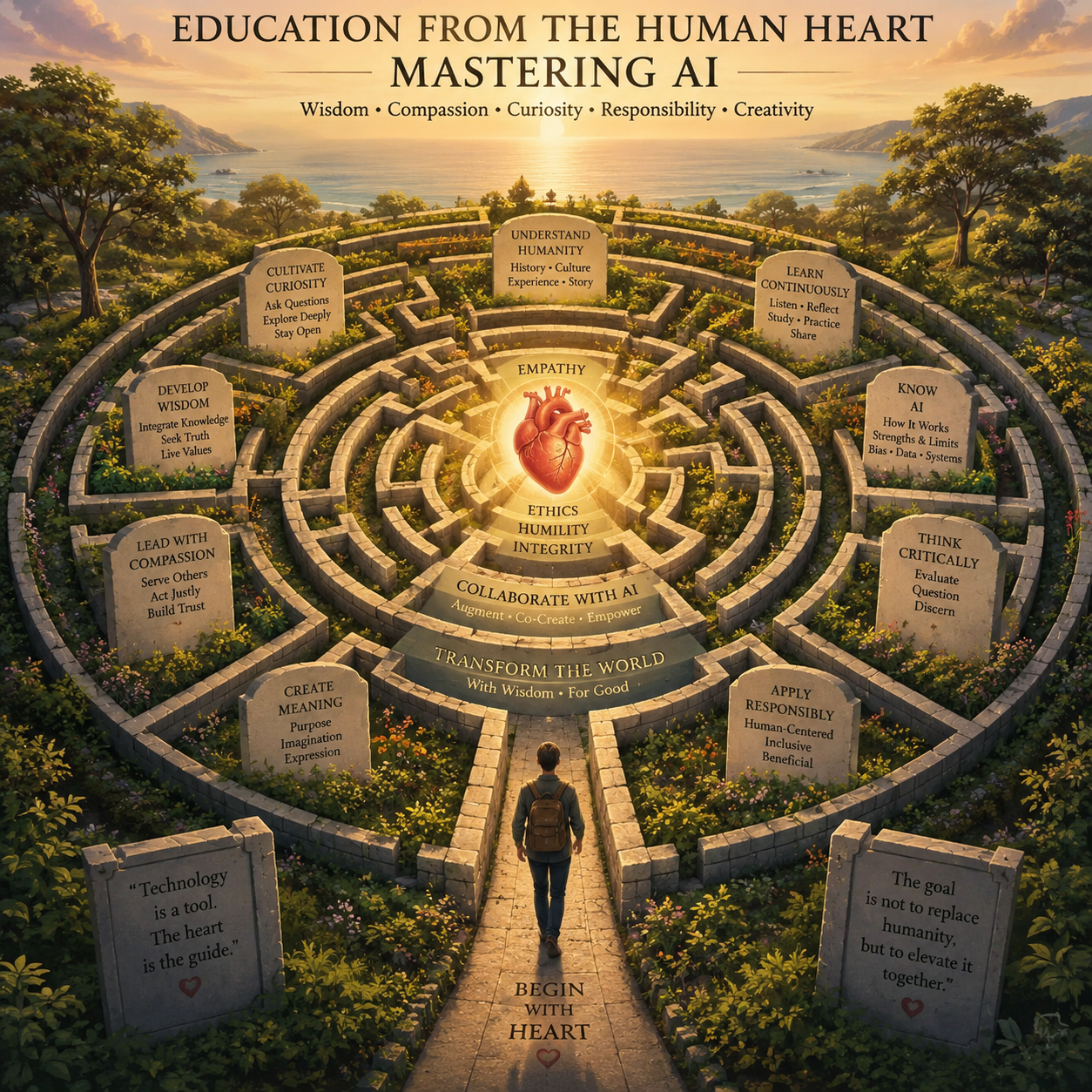
[00:28:40] Speaker C: It prompts. It does the work for us. And we're not. So how do we, how do we bridge our heart to a student's heart? The only way a student will grow is heart to heart. That's the only way a student will grow.
[00:28:53] Lisa Carley: I've seen that many times, many times
[00:28:55] Speaker C: in which to do that. Which you can utilize AI as a tool, but to rely on that is a great divestment of the sanctity and divinity of an individual. Because an individual alone is not divine. It is, but it has an intrinsic divine nature. Inherent, latent divine nature. But a person, a human being is built that our divinity is activated in community or with another.
[00:29:18] Lisa Carley: Yes.
[00:29:19] Speaker C: And so that's, that's the kind of. The caveat of which I operate where we understand AI, but you don't want to build education around that. You want to build education around love.
And I know that it sounds so.
[00:29:33] Lisa Carley: No, it's a hundred percent. I, I feel that every day with my students.
[00:29:38] Speaker C: Yeah.
[00:29:38] Lisa Carley: Like, I try to, I try to bring my passion and enthusiasm for what I'm doing. And you know, like at the Christmas time and at the end of the year, we got, you know, teachers get cards from students and overwhelmingly, like, if I had to do like a grounded theory research on like, the comments that students made in the cards, it was you.
You make it come alive. Like, the way that you engage with the material, it's like your excitement is infectious. And, you know, that's the main thing that I want my students to feel. Right. And that. But, but I guess, like, and I agree with everything that you said, and the only thing that I want to just pull back to and maybe like, pull Rich back into this too, is that I think that, that by having about, oh, you cannot use.
And if you are, it is cheating. It's like we are already making our students the enemy. Right. That we're saying to them, you cannot do this. And if you do this, then suddenly you're a Criminal within our system. Right. I use the word criminal, like, playfully, but, like, you know, you can get sent to, you know, you can get suspended. You can, like, there's all these kind of like, you know, sort of downwind criminal, you know, respons to it. And I don't want to approach it that way with my students. I don't want to take that position with them. I want to take the position of.
Let me understand deeply what is motivating your use of this and how can I help to mitigate whatever that underlying need is.
[00:31:21] Speaker C: Yeah, well, it reminds me, you know, I studied. I have a master's degree from Roswell Park Cancer Institute. And during one of the lectures, we used to have lectures by preeminent leading researchers in cancer at the time.
And one of the researchers at a lecture that I attended said he was a heart and he was in this for the right reasons. But he said, you know, we have this model in medicine that says when a patient with cancer dies, they used to say this. I don't know. I don't think they sort of. They would say the patient failed treatment, the patient failed treatment. And that kind of a similar paradigm to the model of education we're looking at.
[00:32:08] Lisa Carley: Yep.
[00:32:09] Speaker C: We have. You have a garden that's. That's latent and needing to be seeded, that can grow a Dharma. The Dharma is latent and potentiozed. Yep. And you need to find what to plant and how to plant. So before we begin anything, we must understand the dharma of each unique individual, which is different for everybody.
[00:32:27] Lisa Carley: Absolutely.
[00:32:28] Speaker C: The source of growing is love. But the. The needs, the nuances, the subtleties, the calling, the destiny of each soul must be understood before we even begin.
[00:32:39] Lisa Carley: So, Rich, what are your. Like. I mean, maybe you could start with some of, like, the. The actual experiences that you've had with it as an instructor, with your students, an institutional view. And then maybe, you know, how do you handle it individually?
[00:32:56] Rich Grego, Ph. D.: Gosh, yeah. I mean, I have been, you know, it's. Maybe my experience is, in a way, is unique because I've been teaching online exclusively now for so long.
You know, tired. I only teach for one school. I only teach a few courses a year, and they're online. But even my. The last 10 years, I think I. I taught full time online. And that, in a way, is a much different world, lends itself much more to all the.
The negative stuff you guys are talking, you can imagine. Right.
And. And I think that I agree with you guys completely just based on my experience. And. And from, you know, what I hear, you know, of what they're saying in the literature now.
And you just sort of, to put it, everything you guys are saying, and you both sort of said this already, but to put it in that big broad historical, cultural context, you know, we have this system in educational system, but you can say this about all of our system, all of our, all of our social institutions that were invented to address an industrial age.
Very dehumanizing, kind of exactly treat people as commodities and numbers fit a capitalist structure.
Assembly lines, you know, and students through assembly lines. People in the legal system process, people in the medical system right through this sort of assembly line process. And then.
And you know, so we're in an age where we've now conditioned ourselves to treat people like that. We have whole administrations in medicine and law and education, all our institutions that are designed to treat people that way for efficiency's sake and for commercial success.
And then AI comes along that puts, can put that shit on steroids, right? If you want to just turn, you know, if you want to do, turn education or any system in. Into a mindless process and have.
Do it for you by turning everybody, everything else into an algorithm.
I mean, they can do it like that. And then we're wondering why the hell. What that AI is, is that we feel like it's AI that's destroying our system. But I think as you guys are, as you guys say, that it's not that it's.
It's the way we are using, using AI and the way AI is being used by our students because we've. We. That that's the way our, that's the whole. The way our cultural ethos is set up. I. Do you guys agree with that? It sounds like that's kind of what you're saying, right?
[00:35:40] Lisa Carley: Yeah, I think so.
And I, I also, I mean, I guess I also see where AI has been profoundly democratizing because it has given.
I think, because it's free, right? I mean, quote, unquote. And I understand that's a very loaded statement, right? There are downwind costs to people that have, you know, data centers in their backyard. I get all that. But I'm saying that basically anyone can open their laptop and have access to this powerful device.
And the very fact of its existence is allowing me to create something that I never would have had access to ever. I was, I would never have even been able to.
I'm not, I don't have an mba. I wouldn't have been able to write a business plan. I am not a like data analyst. I Wouldn't be able to do all the data analysis that was necessary for me to start building this app. I don't have the technical background. I don't have a degree in computer science that Claude has helped me, someone a little peon with a little bit of an idea, to be like, what could I do with this? And as someone who you've known for 30 years now, as someone who has always had these kind of, like, you know, brainstorm ideas, I haven't been able to go anywhere with them because I didn't have the requisite background knowledge to be able to synthesize the pieces that I needed to synthesize. And this has allowed me to just, you know, completely rethink the whole structure of my life because. And I think to provide something which is ironic because I used Claude to help me build an app to help get. To help get people connected in real life. Life.
[00:37:40] Rich Grego, Ph. D.: Yeah.
[00:37:41] Lisa Carley: That's the whole purpose of the app, is to get people offline and connected in real life.
And, and so I think that just with anything, you know, whatever you do, it's how you use it. And what I try to tell my students is I want you to just. I don't want to have all this moral language around it. I think that's where I'm feeling an opposition to it about, oh, if you use this, you're wrong. If you're doing this, you're cheating. It's like, I want them to use it in a way that will help them perhaps synthesize something that is. Is very, very difficult. And also to get them thinking more creatively. I mean, because I had this idea, it was a very small idea, but over the past three years of working through this app with Claude, I've learned so much. Like, I actually understand, like, the basics of coding now, understand how to write a business plan. And I would have had to take an MBA to figure that out. Right. But because I have this powerful device available to me, this, this resource available to me, it has helped me to grow intellectually and creatively by, By, By. By a mile. And so I guess I just want to reiterate, like, how do we then have this conversation with our students in the classroom?
What is our responsibility as teachers? And how do we get our students to understand that, to take away the morality of the issue. Right. I think that's the part that I don't like, that we make a judgment if you're doing this right. When we know that a hundred percent that their parents are. Their parents at work are likely using AI, right. I live in Silicon Valley and most of their parents are working in tech, and their parents are using that on a daily basis. And so what are we going to tell them? That, you know, the tools that are available to you, you know, you, you shouldn't have access to them. So I guess that's, that's kind of where I'm at with that.
Okay, so in closing thoughts and final reflections, Rich, what are your thoughts about, you know, where you stand with this, both intellectually and I guess also, you know, as a great metaphysical philosopher?
[00:40:05] Rich Grego, Ph. D.: Well, shoot, I'd just like to end on that note, Actually, I'm good with Rich. Grego is a great metaphysical philosopher. Good night. Good night, everybody.
[00:40:15] Speaker C: You know, actually, I wonder what AI. I wonder what AI would say about that.
[00:40:21] Rich Grego, Ph. D.: One quick thing, I'll say this. I'm. I'm teaching right now a course entitled Science, Technology and Society. So as you can imagine, big topic within that is AI and its dimensions and its ramifications. Philosophically, ethically, institutionally, socially.
And one of the things and the students in the class are very cognizant of, and they took mention all the time, is that every new damn technology that has come along since the civic revolution, before the scientific revolution, right, has done, has liberated human potential in some way, right?
And when it first came on the scene, some of them were radical.
[00:41:01] Lisa Carley: The printing press, oh, amazing.
[00:41:04] Rich Grego, Ph. D.: Social media, things like that, automobiles and stuff have radicalized society. So I think AI presents the same kind of challenge.
And again, it's, it's, it's, it's strengths or weaknesses, it's negative or positive effects, you know, who can tell? I think, you know, you guys, you guys noted what they were and might be and what the importance of it is. Very well, thank you both.
[00:41:33] Lisa Carley: Thanks, friends.
[00:41:35] Rich Grego, Ph. D.: Thank you so much.
[00:41:36] Lisa Carley: Okay, take care. Bye.
[00:41:38] Rich Grego, Ph. D.: See you later, guys.